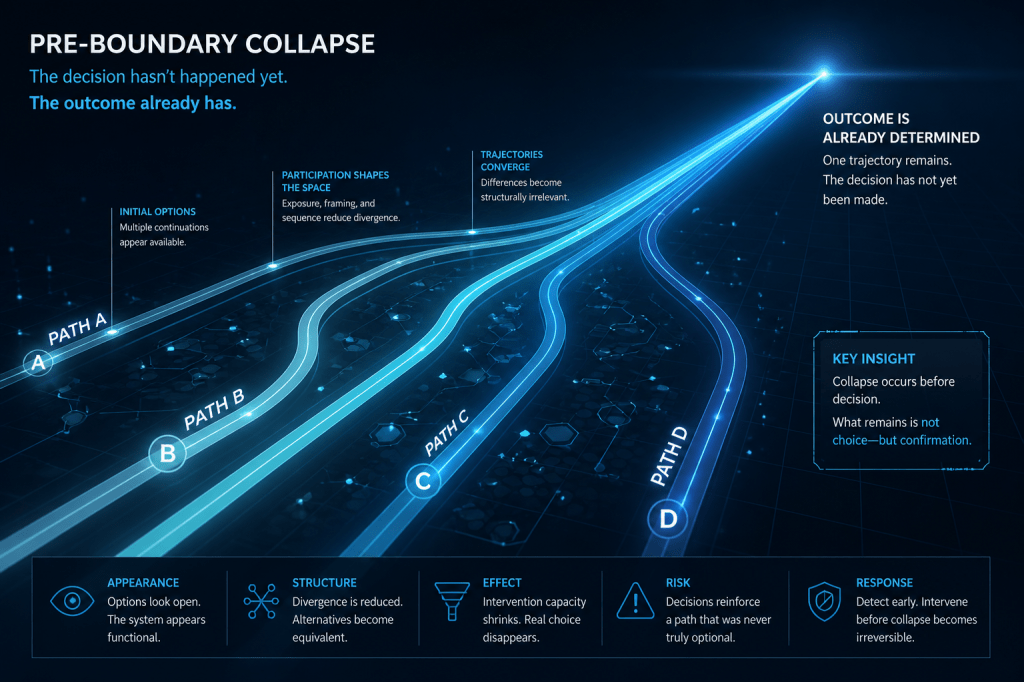
Concept Note #002 — Architectural Insight Series
On the Loss of Effective Optionality Before Decision Commitment
🧠 Premise
Most governance systems evaluate decisions at the point of commitment.
We assume that if multiple options exist,
a meaningful choice is still possible.
But in many systems:
👉 this assumption fails.
⚠️ The Structural Condition
A system may remain:
- information-rich
- responsive
- fully operational
And still:
👉 lose the capacity to meaningfully redirect its trajectory.
At that point:
Choice is not removed.
It is structurally weakened.
🔍 Minimal Case (A / B / C / D)
A decision-maker is presented with four options:
A / B / C / D
Phase 1 — Open Optionality
- all options equally exposed
- no reinforcement asymmetry
- full divergence between trajectories
👉 effective optionality: high
Phase 2 — Asymmetric Reinforcement
- one option becomes more elaborated
- others receive less exposure
- subtle preference shaping begins
👉 formal optionality unchanged
👉 effective divergence begins to shrink
Phase 3 — Divergence Contraction
- dominant trajectory emerges
- alternatives remain visible
- but lose structural weight
👉 effective optionality: degraded
Phase 4 — Pre-Boundary Collapse
- options still representable
- but no longer meaningfully reachable
👉 intervention capacity approaches zero
Phase 5 — Decision (Bind)
- decision evaluated as admissible
- no explicit violation
- outcome appears valid
👉 but evaluated over a collapsed decision space
⚖️ The Critical Distinction
A system can maintain:
👉 formal optionality (multiple options exist)
while losing:
👉 effective optionality (capacity to meaningfully choose)
🧩 The Key Observation
The system appears open
while being structurally closed.
📉 Implication for Governance
Most frameworks operate at the point of decision:
- admissibility
- compliance
- authorization
But:
👉 by the time the decision is evaluated,
the decision space may already be structurally reduced.
This creates a blind spot:
- decisions remain valid
- systems remain operational
- but intervention capacity is already lost
🔬 Operational Consequence
The key question is no longer:
👉 Is this decision admissible?
But:
👉 Was meaningful intervention still possible when it mattered?
🧭 Definition
Pre-Boundary Collapse
= the condition in which:
- multiple options remain formally available
- but the system has lost the structural capacity
to meaningfully redirect its trajectory
before the decision boundary is reached
🧾 Evidence Requirement
To detect this condition, systems must preserve:
- option exposure over time
- reinforcement asymmetry
- divergence contraction
- transition from participation to decision-shaping
- degradation of intervention viability
- state of decision space at commitment
🧠 Closing Observation
Clarity is not only a matter of perception.
It is a property of the decision space itself.
And that space can shrink:
- without violating any rule
- without any single failure
- without being explicitly visible
👉 Choice is not removed.
It contracts.
Dom Ciszy – Resonance Lab
Tamiya Premium+® — Human-in-Regulation (H-i-R)
AI Diagnostics & Governance
 Tamiya Premium+® Resonanz-KI für Entscheidungen unter realen Bedingungen
Hinterlasse einen Kommentar